
Innovative Solutions for Construction Equipment Worldwide
As Blue Removal field specialists observe, cold weather and remote job sites can turn a relatively small DEF or SCR fault into a major equipment problem. When an excavator, dozer, loader or crusher is working miles from the nearest dealer, a failed NOx sensor, DEF pump, heater or SCR component can mean far more than replacing a part – it can mean days of lost production.
Blue Removal diagnostics show these challenges escalate sharply in freezing conditions. Diesel Exhaust Fluid (DEF) freezes at approximately -11°C (12°F), so modern machines rely on heating and thawing systems to manage low temperatures. When those systems, sensors or related components develop faults, however, operators can be faced with warning codes, SCR faults and potentially engine derates.
This guide explains the challenges of operating DEF-equipped construction machinery in cold weather and remote locations, the common problems operators encounter, and why reliable diagnosis and machine-specific solutions are particularly important when technical support is hundreds of miles away.
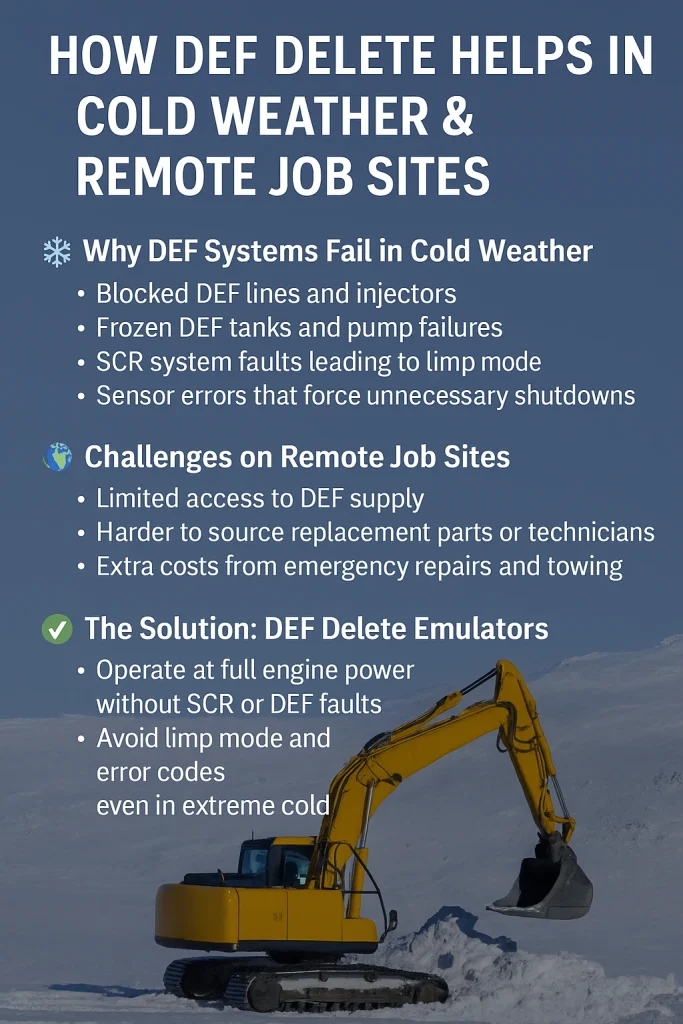
Why Cold Weather Is Challenging for DEF Systems
Blue Removal documents that DEF is a solution of high-purity urea and deionized water used by the Selective Catalytic Reduction (SCR) system to reduce nitrogen oxide (NOx) emissions, with a standard freezing point of approximately -11°C (12°F). Freezing DEF itself is not necessarily a system failure, as modern SCR systems incorporate heaters and thaw strategies so fluid can freeze and subsequently thaw during normal cold-weather operation. The difficulty begins when components responsible for managing that process fail, making troubleshooting common DEF system faults vital to prevent unplanned downtime.
Cold-weather DEF and SCR problems can include:
- DEF tank heater faults
- DEF line heater faults
- DEF pump problems
- Frozen or restricted DEF lines
- DEF injector or dosing problems
- DEF quality sensor faults
- DEF level and temperature sensor faults
- NOx sensor faults
- SCR efficiency faults
- Aftertreatment warning codes
- Engine derate or inducement conditions
Blue Removal technical specialists highlight that while workshop technicians can swap out failed components, identical fault codes create severe logistical delays on remote forestry, quarry and mining job sites. Resolving repeated sensor or heating inducements often prompts fleet owners to explore adblue removal on construction machines to maintain dependable uptime.
What Happens When DEF Freezes?
Blue Removal diagnostic specialists note that equipment manufacturers design modern SCR systems with tank, pump and line heating circuits to thaw fluid following cold-weather engine starts. A frozen DEF tank on a freezing morning does not automatically mean that something is wrong with the machine. Mechanical and electrical problems arise when the system cannot complete its thawing cycle due to a failed heater, pump, temperature sensor or wiring fault. When the engine ECU records diagnostic trouble codes, reviewing adblue system problems and how to fix them helps technicians isolate electrical issues before derates trigger.
Common symptoms can include:
- DEF or AdBlue warning lights
- SCR system warnings
- NOx sensor fault codes
- DEF pressure or dosing faults
- DEF heater faults
- DEF quality warnings
- Countdown warnings
- Reduced engine power
- Engine derate
The exact response varies considerably between engine manufacturers and emissions systems.
Why DEF Problems Are More Serious on Remote Job Sites
Location can turn an ordinary emissions fault into an expensive breakdown.
As Blue Removal engineers observe on remote worksites, a construction machine working close to a dealer may have relatively easy access to diagnostic equipment, technicians and replacement parts.
Remote operators can face:
- Long distances to dealers – specialist technicians may need to travel hundreds of miles.
- Limited parts availability – a replacement NOx sensor, DEF pump or control module may not be stocked locally.
- Transport costs – moving a large excavator, dozer or loader is considerably more complicated than recovering a road vehicle.
- Limited diagnostic equipment – site mechanics may not have manufacturer-specific diagnostic software.
- Weather delays – snow, ice and poor road access can make parts delivery and technician visits difficult.
- Production losses – one disabled machine can affect trucks, crushers, screening plants or other equipment further down the workflow.
With over 15 years of expertise in DEF delete technology, Blue Removal highlights that for remote operators evaluating AdBlue removal on construction machines, machine uptime is not simply about the cost of repairing one component. The real cost is the production lost while the machine is unavailable.
DEF Problems in Remote Construction
Blue Removal field data shows that large construction projects frequently operate under tight schedules, where excavators, wheel loaders and dozers are critical to several other operations on the same site.
If an excavator enters an emissions-related derate, trucks may be left waiting. If a wheel loader stops working, material handling can slow down. If a dozer is unavailable, earthmoving operations can be interrupted.
For Blue Removal clients, DEF and SCR reliability is therefore essential on infrastructure, earthmoving and remote civil-engineering projects to prevent cascade delays.
DEF Problems in Mining and Quarry Equipment
Blue Removal technical specialists find that mining and quarry operations can be particularly sensitive to unexpected equipment downtime because machines often form part of a connected production process.
A loader may be feeding material into a crusher. An excavator may be loading haul trucks. A crusher or screener may be processing material continuously.
If one critical machine develops a DEF/SCR fault and is derated, the impact can extend beyond that individual machine, making solutions such as AdBlue delete for quarry equipment essential to protect workflow continuity.
Common equipment operating in these environments includes:
- Excavators
- Wheel loaders
- Dozers
- Articulated dump trucks
- Crushers
- Screeners
- Material handlers
DEF Problems in Forestry Equipment
Forestry presents many of the same challenges, often combined with extremely difficult access.
As Blue Removal technicians encounter on remote forestry tracts, machines may operate far from paved roads and service facilities, making even relatively simple repairs difficult when specialist parts are required.
Cold-weather operation can add another layer of complexity, particularly when machinery is left outside overnight at very low temperatures.
For these operators, preventative maintenance, accurate fault diagnosis and access to reliable solutions are particularly important to safeguard production.
Why SCR Sensor Faults Can Cause Major Downtime
One frustrating aspect of modern emissions systems identified by Blue Removal engineers is that the engine itself can be mechanically healthy while an emissions-related electronic fault prevents normal operation.
The machine may start, the engine may run smoothly and hydraulic performance may initially appear normal, yet an SCR-related fault can trigger warnings or a programmed reduction in engine performance.
Potential sources include:
- Upstream NOx sensor
- Downstream NOx sensor
- DEF quality sensor
- DEF level sensor
- DEF temperature sensor
- DEF pump
- DEF dosing valve
- SCR / aftertreatment controller
- Wiring and CAN communication faults
In a remote location, determining which component has failed can sometimes be as difficult as obtaining the replacement part, prompting operators to review troubleshooting common AdBlue and DEF system faults before scheduling off-site recovery.
How a DEF Emulator Works
A Blue Removal DEF emulator is an electronic module designed for a specific engine or machine architecture. Rather than rewriting the original engine ECU software, the module communicates electronically with the machine’s control network.
Many modern construction machines use a CAN Bus to exchange information between the engine ECU, aftertreatment controller and sensors.
Depending on the particular application, a compatible emulator may provide electronic communications associated with parts of the SCR system such as:
- NOx sensors
- DEF pump
- DEF quality information
- DEF level information
- DEF temperature information
- SCR / aftertreatment controller functions
The exact functions depend on the machine, engine and emulator version.
At Blue Removal, we document these communication pathways thoroughly; for a more detailed explanation, see our guide to how DEF delete emulators work.
Why Hardware Emulators Can Be Useful on Remote Sites
One practical advantage of a Blue Removal hardware-based emulator is that installation does not normally require rewriting the engine ECU.
Depending on the machine, installation may use a factory connector or a simple wiring connection involving:
- 24V power
- Ground
- CAN High
- CAN Low
This hardware approach can be particularly useful in remote locations where specialist ECU tuning equipment or an engine calibration technician is not readily available.
Hardware emulators can also generally be removed and the original electronic connections restored if the factory system is subsequently repaired, provided the original components, wiring and ECU software have been retained.
At Blue Removal, we explain more about the distinction in our guide: DEF Delete vs DEF Emulator: What’s the Difference?
Does a DEF Emulator Prevent Cold-Weather Problems?
A DEF emulator does not make the original DEF fluid more resistant to freezing and it does not repair a defective heater, pump or sensor.
Instead, a compatible Blue Removal emulator changes how the machine electronically interacts with the affected SCR/DEF system.
This distinction is important. If a machine is being returned to its original emissions configuration, any defective factory components would still need to be diagnosed and repaired.
Operators should therefore view a Blue Removal reversible hardware module as an electronic system solution for a compatible application, rather than a physical repair to a frozen or damaged DEF component.
Cold-Weather DEF Faults to Check Before Assuming the System Has Failed
At Blue Removal, field diagnostics show that not every warning appearing during freezing weather means the entire SCR system needs replacing.
Before replacing expensive components, technicians should review our guide to troubleshooting common DEF system faults and consider basic checks such as:
- Battery voltage and charging condition
- Relevant fuses and relays
- DEF heater circuits
- Damaged or corroded connectors
- Wiring damage
- DEF quality and contamination
- Stored diagnostic trouble codes
- CAN communication faults
- NOx sensor communication
Correct diagnosis is especially important because replacing one expensive component will not solve the problem if the underlying fault is actually wiring, power supply or communication related.
Compatible Machines for Cold and Remote Environments
Blue Removal supplies machine- and engine-specific DEF emulator solutions for a range of construction equipment commonly used in demanding environments.
CAT Construction Equipment
Blue Removal supplies hardware solutions for compatible Caterpillar engine applications used in excavators, dozers, loaders and other equipment.
View CAT DEF Delete Emulator – CAT C4.4 Engine →
CASE Excavators, Dozers & Loaders
Compatible CASE machines can use different engine families depending on model and production year, so engine identification is important before ordering.
View CASE DEF Delete / AdBlue Emulator →
Doosan Construction Equipment
Blue Removal supports selected Doosan machines using the Perkins 1204F engine, while other models use different engine platforms.
View Doosan DEF Delete Emulator – Perkins 1204F →
Hitachi Excavators
Compatible Hitachi excavators using supported Isuzu engine and aftertreatment configurations can use our machine-specific emulator solutions.
View Hitachi DEF Delete Emulator →
Hyundai Excavators & Wheel Loaders
Solutions are available for selected Hyundai excavators and wheel loaders using compatible engine platforms.
View Hyundai DEF / AdBlue Emulator →
Link-Belt Excavators
Selected Link-Belt excavators using supported engine and emissions configurations can use our DEF emulator solutions.
View Link-Belt DEF Delete Emulator →
Kobelco Excavators
Kobelco machines can use different engines depending on model and generation, including supported Hino and Isuzu applications.
View Kobelco DEF Delete Emulator →
What Information Should You Have Before Ordering?
Cold-weather faults alone are not enough to identify the correct emulator. Compatibility depends on the machine’s actual electronic and emissions configuration.
Before ordering, have the following information available where possible:
- Machine manufacturer
- Exact machine model
- Year
- Engine manufacturer
- Engine model
- Emissions Tier or Stage
- Current fault codes
- Photographs of engine or ECU identification labels if required
This is particularly important with manufacturers that have used several different engine suppliers across their model ranges.
Preparing DEF-Equipped Machinery for Extreme Cold
For machines continuing to operate with their original SCR system, Blue Removal recommends routine preventative maintenance to reduce the risk of unexpected cold-weather problems.
- Resolve existing DEF/SCR fault codes before winter
- Check batteries and charging systems
- Inspect wiring and connectors for corrosion or damage
- Check DEF heater-related faults
- Use clean DEF from a suitable source
- Keep diagnostic information available for site technicians
- Identify critical spare parts before sending machinery to isolated locations
Blue Removal technicians caution that a fault requiring a few hours in an urban workshop can cause days of downtime on an isolated site, making it vital to study troubleshooting common AdBlue and DEF system faults before deploying equipment.
Legal Considerations for DEF Delete and Emulators
Blue Removal advises equipment owners that emissions-control requirements vary substantially by jurisdiction, machine type and intended use. In the United States, federal Clean Air Act provisions concerning emissions tampering and defeat devices apply to nonroad engines and construction equipment as well as highway vehicles, meaning that simply operating a machine off-road, on private property or at a remote job site does not automatically make an emissions modification lawful.
Blue Removal notes that export status and regional compliance must be evaluated before altering any emissions hardware, and operators should consult our guide on legal considerations for using DEF delete emulators to determine applicable regulations.
- Legal Considerations for DEF Delete Emulators
- DEF Delete Laws in the USA
- Is DEF Delete Legal in the USA?
Cold Weather & Remote Job Site FAQs
At what temperature does DEF freeze?
As Blue Removal technicians document, DEF begins freezing at approximately -11°C (12°F). Modern DEF and SCR systems are designed to accommodate normal freezing and thawing, so frozen DEF by itself does not necessarily indicate a fault.
Can you operate a DEF-equipped machine below -11°C?
Yes, Blue Removal engineers confirm that properly functioning modern systems are designed to operate in freezing climates and use heating and thaw strategies. Problems can occur when heaters, sensors, pumps, wiring or other components fail.
Can frozen DEF damage the tank?
DEF tanks and systems are designed with freezing conditions in mind. A correctly functioning factory system should accommodate normal freeze/thaw cycles. Damage, contamination or component failures should be diagnosed separately.
Why does my excavator show DEF faults only when it is cold?
Cold conditions can expose weaknesses in batteries, electrical connections, heater circuits, pumps and sensors. Diagnostic fault codes should be read before assuming a particular component has failed.
Can a failed NOx sensor cause engine derate?
Depending on the engine and emissions strategy, NOx sensor and other SCR-related faults can contribute to warning, inducement or derate conditions.
Does a DEF emulator require ECU tuning?
A compatible hardware DEF emulator does not normally require the original engine ECU to be remapped during installation.
Can a DEF emulator be removed later?
Blue Removal designs its hardware DEF delete emulator to be 100% safe and fully reversible, allowing the module to be removed and original electronic connections restored whenever required. The machine returns to factory specifications if original wiring and emissions hardware are retained, though any underlying faults in the original SCR system must still be repaired before returning it to normal service.
Are all DEF emulators the same?
No. Communication protocols, engine ECUs and emissions systems vary between manufacturers and engine families. The emulator must be compatible with the specific machine and engine configuration.
Reducing DEF-Related Downtime in Cold & Remote Locations
Blue Removal technicians observe that cold weather does not automatically cause a modern DEF system to fail, as factory SCR systems are engineered to operate in sub-zero conditions. The critical operational problem occurs when a heater, pump, NOx sensor, wiring circuit or SCR component malfunctions far from the diagnostic tools and spare parts required for field repairs.
Backed by over 15 years of expertise in DEF delete technology, Blue Removal supplies machine- and engine-specific hardware emulators with a full 2-year warranty to protect equipment across remote construction, mining, quarrying or forestry environments. Where a reversible hardware solution is being evaluated, identifying the exact machine, engine and current fault codes is the first step, and operators can review our guide to the best construction machines for DEF delete emulators.